It is no accident, Ma, that the comma resembles a fetus – that curve of continuation … (Ocean Vuong )
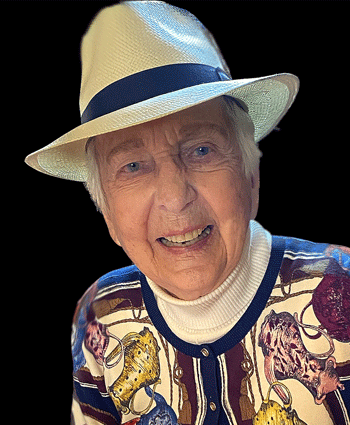
I’ve written at length on this site about losing my partner of 43 years last April. Before that, however, on this day one year ago, my mother, Lorna Spencer Hedges, crossed over at age 97 at her home in Santa Barbara, California. Her terminal decline had been extremely precipitous. I was fortunate to be able to fly out from Colorado in time to help with her care during her last few days and to be present at her bedside, stroking her hair, as she drew her final breath.
There’s not much that I want to say here about my mother’s life other than that she was a remarkable woman by any measure, widely appreciated and admired for her energy and gracious charm, and for her avid support of the fine arts and arts education in her community. Her greatest gift, in my opinion, was her ability to form strong, mutually caring relationships with the people around her. She will be long remembered as someone who brought a little light to a lot of lives.
I’m afraid, though, that things weren’t always so copacetic when it came to dealing with a difficult daughter. Our relationship was rather enmeshed when I was a child, and nothing if not complicated once I was an adult. Still, for all the contention that could arise between us, there was genuine love, and that love prevailed through all the bullshit to bring us to that final intimacy as she slipped away.
The following poem is based in part on a vivid dream that I had while sleeping in the room next to Mom’s the morning that she passed. In it, I was approaching an underwater cave when I saw a pair of hands emerge, releasing a large golden fish wearing my mother’s face. It rushed by me, as if eager to hit the open water, and then my visual field shifted to a panoramic view of an endless aquamarine sea. I awoke to realize that my mother’s time was imminent. And indeed, she and I were both letting go as she drew her final breath a half hour later; with me whispering I love you – I love you – I love you in her ear, knowing that those were the words she most wanted and needed to hear:
FOR LORNA

You slipped from my grasping hands
                                                         like a fish
In the running stream

Beneath my gaze and out of sight
A final sigh
                 dissolving in the open air
That love is forever, Mom. May your journey in that infinite sea be tranquil and full of wonder …
To be loving is to be open to grief, to be touched by sorrow, even sorrow that is unending … (bell hooks)
I’ve dwelt at length in my previous post on the loss of my partner Laura five and a half months ago and the experience of mourning her in those early weeks after her passing. It’s still early days, to be sure, and the hole in my heart remains acutely tender. Even so, where at first there was only an aching void, the emptiness is starting to give way to grateful memory and moments of unaffected appreciation for what we had shared together for over 43 years. As my chest fills with a palpable warmth on such occasions, I come to realize that though our relationship has been radically transformed, my bestie is still alive and present within me, in the love that had grown between us and still remains.
That said, but for such epiphanies of grace and comfort, I’m not sure I could endure the bouts of intense heartache that continue to make themselves felt with astonishing regularity. The tears flow freely – sometimes for myself, but even more for Laura and for the frustrated liveliness that her frail body could no longer sustain. And now that the natural world is starting to turn in on itself with the shorter days and longer nights, the pangs of desolation seem to hit home that much harder despite the passage of time. By late August the seasonal changes were already noticeable when I wrote the following lines:
SPARROWS – for Laura G

It was in the heart of spring
When your own gave out
                                      and mine
Fell open beneath my throat

Letting go a thousand sparrows
To join my sorrow to the sky

Now the nights are growing longer
Leaning into fall
                         and moments when
                         in the dark
I think I might awaken from this dream

To slip Inside your room next door
To tell you all about it
                                  if only
                                  I could
t seems almost a sin to be so focused on one’s personal grief when the world at large is in such crisis as to threaten world war abroad and harsh authoritarian governance here at home. But the truth is, I find myself crying over these things, too, hardly able to help myself. If anything, the flood of feeling occasioned by my partner’s passing has put a crack in my heart’s accustomed defenses. Whether faraway in places like Gaza or Ukraine, or up close on our American streets, the atrocities keep piling up day after day to the point where the violence and rank injustice have become nearly normalized in public discourse, if not the public’s mind. For anyone whose heart has become as raw and exposed as a hermit crab caught out of its shell, the outrage and sorrow of it is nothing if not soul-crushing.
What ultimately counts when encountering such collective extremity, of course, is not just how one feels, but what one does about it. It’s up to everyone with a conscience to act as best they can where they can in the ways that they can. That’s no less true for poets and writers as well, particularly when it comes to the exercise of their craft. As Albert Camus declared on receiving the Nobel Prize for Literature in 1957, [T]he writer’s role is not free from difficult duties. By definition he cannot put himself today in the service of those who make history; he is at the service of those who suffer it …1
This is where I have a problem. I don’t know whether to count it as a character failing or as a simple lack of talent, but I have a difficult time taking on explicitly social or political themes in my poetry. Not that I don’t make an earnest effort from time to time, looking to give voice to the strong feelings I have about various issues, but the results have rarely been satisfying from either an artistic or expressive standpoint. I usually end up setting these attempts aside, thinking that I might be able to repurpose some of the juicier lines later on down the road.
There have been the odd exceptions, though, such as this poem I wrote in response to Joe Biden’s inauguration in 2021. It doesn’t make explicit reference to the event except for the date and play of words in the title, but manages to convey an almost physical sense of release in the wake of Donald Trump’s failed coup attempt and the promise of a more enlightened leadership taking over in the Oval Office:
INAUGURY – January 20, 2021

It was no ordinary day
                                  the winter sky
Seeming a little wider
                                 and not so ashen
                                 or sedimentary

As to weigh down hard against the eye

Or put a ceiling on these wingbeats
Buried deep inside my chest

Beneath the layers of a muscled caution
Making it labor just to breathe

Much less sing
                      like a bird
                      perched
With unwavering abandon

On the rise and swell of its natal cry
By contrast, when Trump won reelection last November, it was all I could do to offer up an emotional weather report:
NOVEMBER 2024

Fall’s first snow
                        unseasonably wet
Lying thick on the ground

And weighing on the tree branches
Still half in leaf

                        pressing down
Like the leaden skies overhead
And a mind full of gray clouds
                                              no horizon
                                              in sight
It’s possible, of course, that not all poetry has to engage explicit political or social content to bear effective witness to the historical moment. It may be enough for a poem to angle beneath the topical surface to raise the reader’s consciousness from underneath, as it were, leveraging the action of archetypal energies inhabiting the basement of the psyche. In a letter he wrote to Wendall Berry back in 1977, Gary Snyder makes exactly this point: As poets, our politics mostly stand back from that flow of topical events; and the place we do our real work is in the unconscious, or myth-consciousness of the culture; a place where people decide (without knowing it) to change their values …2 As a poet temperamentally drawn toward an aesthetic of Rilkean introspection, I find these words particularly reassuring.
I’ll finish here with a piece that I wrote shortly after Trump’s first inauguration in 2017 in response to his shocking rise to power. Without referring explicitly to either the man or the event, the poem seeks to register a particular feeling tone using tropes and imagery that “Inaugury” would echo four years later to contrasting effect:
AUSPICE

Freedom is a strange thing. Once you've experienced it,
it remains in your heart and no one can take it away …
(Ai Weiwei)

Not hope
              we're past that now
But cupped close to the heart
A quavering warmth
Nestled egg-like in a gesture
Of folded wings
                        and chapped fingers

Bitten with cold
                        this memory
                        of traceless flight
Across an unbounded
Blue horizon

                   and soft
Like a brush
                   of outspread feathers
A fugitive stroke of shadow
Traversing the open snow

Beyond hope
                    yet so much closer
Hollowed out inside our bones
What is most ourselves
                                   grown birdlike
And resolute in our natal freedom

Rising on the wellspring
Of the world's
                     first imagining
The angel that we are
Robed in earth and holy yearning

A prayer we've not forgotten
But woven throughout this flesh
And breath
                 these bodies
                 a beating heart
Bent to power
                     beyond dying
The groundswell beneath our feet
My irrepressible bestie hated bullies and wasn’t ever afraid to stand up to them, not even as her health was growing visibly frail. Even so, when I contemplate the harsh reactionary turn that politics have taken here at home, I can’t help but take a kind of backhanded solace in the fact that she’s not around to suffer the shitshow that our country is fast becoming. For my own part, there’s nothing to do but lend my diffident shoulder to the wheel like any other writer or artist seeking in the creative imagination a worthy means to defend against the ruination of the world.
On the afternoon of April 23, 2025, my best friend and partner of 43 years passed away at age 71 after struggling through a succession of acute medical challenges that, in the end, simply wore her body out. What really sucked, however, was how precipitous her final decline turned out to be. Up until the last two weeks of her life, the tight circle of friends and loved ones gathered around her care had every expectation of her being with us for a good season or two – & of us being able to sweeten the final turn of her strenuous but fruitful passage on this earth.
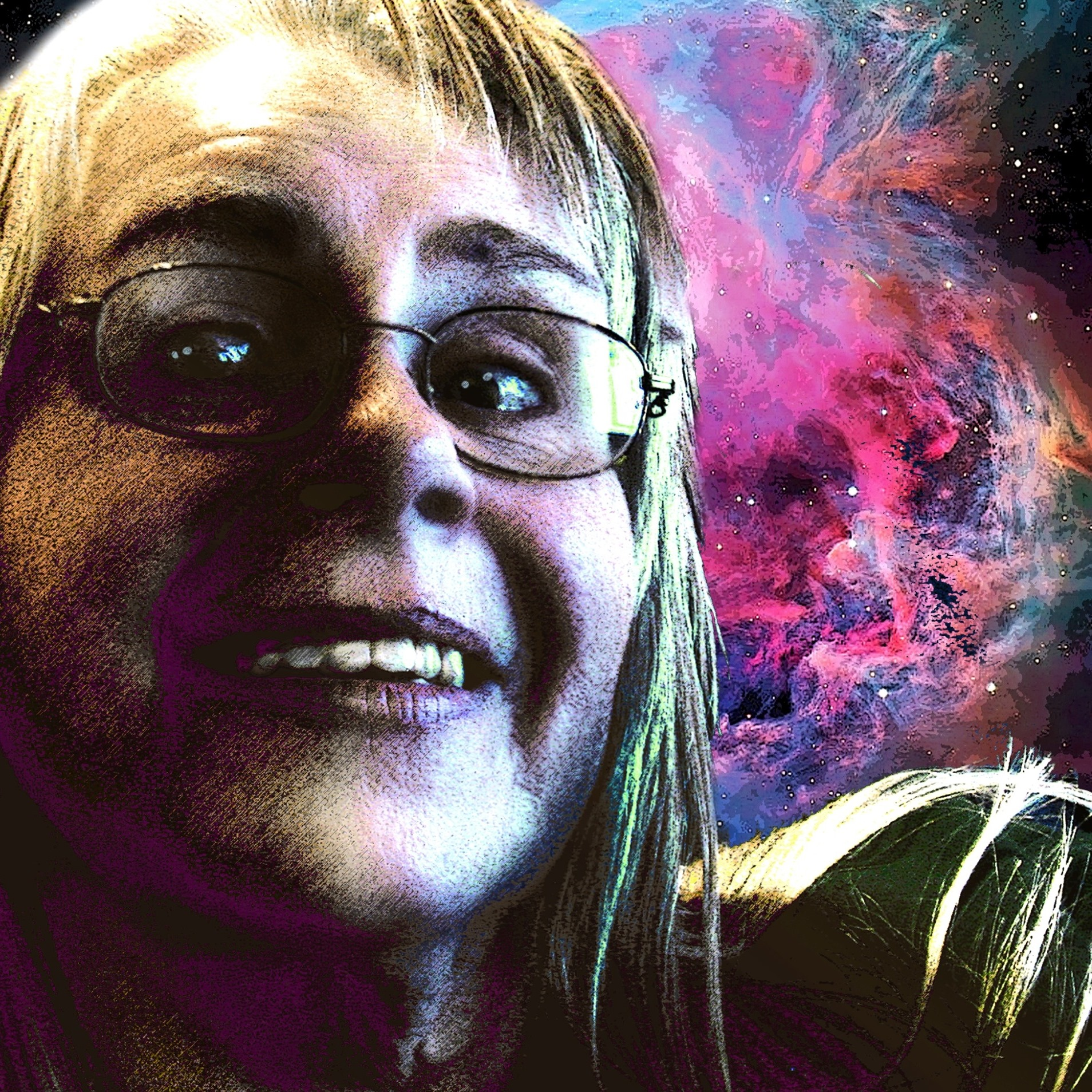
In life, Laura Renee Givens was an inspired fireball whose outsized personality, imaginative reach, and offbeat sense of humor defied any set of conventional expectations while propelling her to explore a diverse range of creative and artistic endeavors. Although best known for her innovative work as a digital artist, she also found recognition as the author of quirkily inventive science fiction and fantasy, and – while her stamina was up to it – as a serious player in Denver’s lively improv theater scene. Although she never quite made the “big time” commercially in any of these fields, Laura garnered the respect and admiration of many who did – not just on account of her talent, but for the pluck, resourcefulness, and keen enthusiasm she brought to any project. Most importantly, though, she was a good friend to all who entered her circle, no matter whether the relationship was professional or strictly personal. It’s not that my bestie was blind to people’s smudges, but that once she let someone in as a friend or colleague, her constancy and good faith were as close to absolute as one could ever hope to see in a human being.
As in life, so in death – even if only as an echo … Laura’s body may have gone the way of all flesh, but something certainly remains of the creative energy she embodied in her person that continues to ripple through the world. To be sure, there is the writing and artwork she left behind, but likewise – if more subliminally – the impress she left by her sheer presence on the people around her, particularly those she worked with in different capacities through a long and varied career.
All that said, it’s not my intention here to gloss up the fertile complexity of my partner’s life with a summary list of highlights and the usual hagiographic flourishes. (As it is, I may have gotten dangerously close …) Laura was emotionally complicated, as many creative people are, and not always easy to get along with. Yet she was possessed of an uncommon light that still burns brightly for those of us who knew her, even if only as reflected in conscious memory and in the subtler realm of our dreaming. In her absence, she remains remarkably present – and it’s just that sense of discarnate proximity that I mean to touch on here with a couple of poems I’ve written since her passing.
I finished this first one on the morning of what would have been Laura’s 72nd birthday, a little less than a month after she passed – just in time to read it at a memorial sendoff and celebration of life organized by a group of our friends. It is addressed to one whose eyes and ears are past being able to read or hear it, yet whose gaze persists to palpably haunt the speaker’s own:
BELOVED – for Laura G, in memoria

Your wide eyes are the only light I know
from extinguished constellations … (Pablo Neruda)

This life
            like a wisp of cloud
Bleeding into an infinite blue sky

And yet so much more
                                   how
A beloved's presence can abide
Beyond death
                     like ancient starlight

Bearing the impress of stars long bygone
In a kind of timeless perpetuity

So your gaze continues to fill my horizon
Like moonlight filtering through the predawn mist

Or a persistent echo
                               at the edge of hearing
In the interstice between memory and dreams
As evanescent as a cloud taking shape and disappearing in the space of a summer afternoon, such is human life. And yet, as Vietnamese Zen master Thich Nhat Hahn often liked to point out, while the cloud might seem to disappear, it never really ceases to exist, but undergoes the various transformations of its watery essence – rain mist, snow, etc. – as part of a vast planet-wide cycle that, among other things, sustains the very possibility of life on this Earth. Indeed, it takes only a little reflection to be able to envisage traces of that cloud almost everywhere we look, including our own bodies and just about everything we do.
By holding up the cloud as an example, this much venerated teacher was making a point about the fundamental nature of our own existence in all its humanly multidimensional complexity. Laura’s ashes will nourish the soil of the mountain valley where I’ll be spreading them later this year, but in the meantime and well beyond, her imprint will be felt across many human neuroscapes, both through her art and the mediation of conscious and subliminal memory. The embodied person as we knew her may be no more, but her presence persists in these rippling traces of her character and creative energy – a little like the light of a long-spent star reaching us from beyond the event horizon of deep space …
And yet, and yet … For all that, there still remains the acute sense of personal loss that typically takes over a person’s inner world on the death of someone dearly loved. That has certainly been true of my own experience in these early months, especially during the first weeks while I was writing this poem. There’s little in the poem itself, however, to allude to such feelings of sorrow directly, allowing them to emerge contextually from between the lines. What stands out, rather, is the speaker’s bemusement at the beloved’s transformation – no longer warmly, personally present as she was while alive, but reduced to the rippling traces of a life that has run its course, to be recomposed in this world only within the scope of memory, dream, and imagination. If anything – for the bereaved, at least – the beloved is liable to become most acutely present precisely on account of the void left behind, an absence so intensely felt that it takes on palpable substance and gravity, enough at times to bend one’s entire subjective universe around the ache and sense of deprivation. The fact that life itself must inevitably move on, ultimately indifferent to our human feelings, only casts a pall of isolation over this all-consuming grief, redoubling its force back onto the heart of the bereaved.– On my heart, certainly, in what is still early days; as voiced in the following poem, which came to me during the second month after Laura’s passing:
ECHO – for Laura G

But for this ache inside me
Would not this
                       rolling world
Have swallowed you entirely under

With the seamless indifference
Of a broad flowing river
                                     moving on
                                     and on

And on
            but for this empty space
Where once you sat so comfortably

And the impress of your beating heart
Still resonates
                      an echo
More real than any mere memory -?-
Finishing up, I want to offer yet one more poem to balance out the picture, lines that virtually fell into my lap a few days ago as I was working on this piece. It’s the straight goods, telling exactly what it’s been like to carry my bestie’s impress so deeply in heart … For all that is painful, there is also tremendous consolation:
CIRCLE OF TWO – for Laura G

I hold out my arm sideways
As if to give you a little hug

As I used to do
                       sitting beside you
                       on the bed or couch
Just the two of us

                           sharing a moment
                           talking
Or watching a movie as you loved to do

And I can still feel the round curve of your shoulders
And the warmth of your body next to mine

It’s precious little
                           and yet so much
That I hope never to lose

Nor the bright timbre of your irreplaceable voice
When I hear you call out Coli!
                                             like a bell
From somewhere beyond the sky
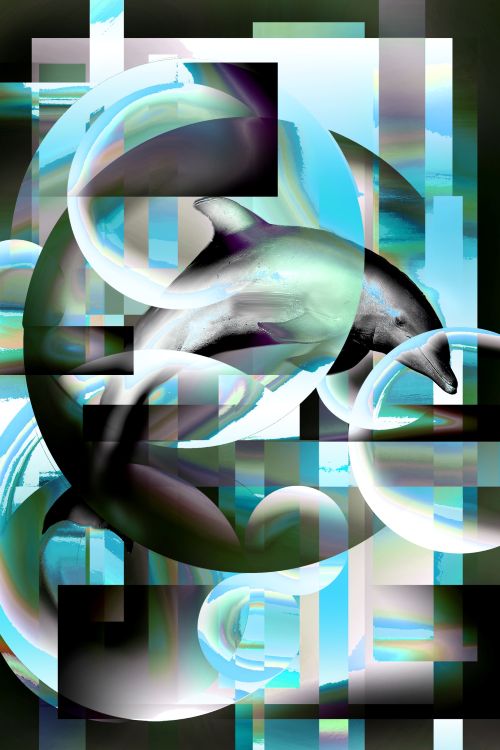
Also, a sample of Laura’s art, a digital piece that really resonate with how I’ve come to envision her omni-dimensional arrival back into the ocean of Being …
People who read poetry have heard about the burning bush, but when you write poetry, you sit inside the burning bush … (Li-Young Lee)
I’m a rather private person who doesn’t much like talking about her personal life and history except where some episode or detail bears directly on the subject at hand. I’d much rather let the productions of my art speak for themselves – and for me – as a creative sublimation of the expressive impulse and life experiences in back of them. That said, however, I’d be remiss if I didn’t open this blog with at least a suggestion of what I’m about.
There is likely no single satisfactory way to define what poetry is or ought to be. The field is informed by such a complex history of practices and critical perspectives that one would do better to think in terms of poetries rather than “poetry” in general. Poetry is as poetry presents itself at a given time and clime – which is to say, as poets write it according to the dictates of their sensibilities and conscience. In my own case, what I value most in the medium is the opportunity it affords to stretch the resources of language beyond their usual capacities in order to point to what would otherwise remain outside their power to express. – A little like using a finger to point up at the ungraspable moon … In this wise, my poetic aspirations lean toward the inwardness of a gaze turned back on itself, cultivating a kind of double vision mediating between so-called “objectivity” and the subjective undercurrents feeding into conscious perception.
The poems I find myself writing are generally short and unabashedly lyric in intent, hearkening back to the manifold aesthetics of the old “deep image” poets combined with a feeling for organic form. My poetics could well be considered “retro,” then, from the standpoint of a lot of contemporary criticism, but those kinds of judgments – as interesting as they might be in their own province – remain outside the legitimate preserve of my creative process, where all that really matters is that the poems themselves are honestly delivered from that imaginal space where dreaming and intellection are in constant dialogue to make sense out of my astonishment at life. “Only truthful hands write true poems,” asserted Paul Celan. “I cannot see any basic difference between a handshake and a poem.” Neither can I …
I’ll wrap up this first post with a sample poem that happens to touch on my creative process. I wrote “Poeisis” back in early 2020 after encountering the following lines attributed to the celebrated Punjabi writer and poet Amrita Pritam (1919-2005):
There was a grief I smoked in silence, like a cigarette –
Only a few poems fell out of the ash I flicked from it …
This moment occurred just as the impact of the COVID pandemic was starting to be felt here in the U.S. The image of a woman smoking her grief in silence with poems falling from the ash struck a deeply resonant chord with how I was feeling at the time, inspiring me to take it a step further in a poem of my own:
POIESIS (after Pritam)

Like flakes of ash on white snow
These words gather
           falling
As of their own accord

Dreaming this poem to its contour
As I sit by
       going up in smoke

Like the clouds inside my coffee cup
A coronal bloom
          in the hollow of my throat

Where the heart
         letting go
Lapses beneath itself to fallow silence

Cupped in its solitude like a well
Floating its nebular traces
A poet’s lot, as Li-Young Lee declares in the epigraph opening this piece, is not merely to bear witness to the burning bush, but to find oneself sitting inside it. Pritam’s image of the poet “smoking” her grief suggests that she’s talking about some sort of emotional auto-immolation following the experience of a catastrophic loss. But being a poet, she’s also able speak of harvesting a few poems out of wreckage and desolation. – Only a few, as she takes pains to tell us, but I can’t help but suspect that they gave voice to something very powerful …

 Projet 山川